
Government vs Private vs Deemed Medical College for MD/MS: Fees, Competition & What You Should Consider

After NEET PG, one of the biggest decisions is not simply which branch you want.

It is also: Which type of medical college should you consider for your MD/MS?

You may have options across:

  • Government medical colleges
  • Private medical colleges
  • Deemed universities
  • Different counselling rounds
  • Different states and locations
  • Different fee structures

And the same NEET PG rank can lead to very different possibilities depending on your branch preference, category, budget, domicile and counselling strategy.

This is why choosing an MD/MS college only by looking at its name or fee can be misleading.

The better approach is to understand how government, private and deemed medical colleges differ — and then compare the options that are actually relevant to your rank and priorities.

Government vs Private vs Deemed Medical College for MD/MS

FactorGovernment Medical CollegePrivate Medical CollegeDeemed University
Tuition feesGenerally lower, but varies by state/institutionCan vary widelyOften higher, depending on institution and course
CompetitionOften high for sought-after branchesVaries by college, branch and counselling routeVaries by college, branch and round
Admission routeNEET PG + applicable counsellingNEET PG + applicable state/MCC counsellingNEET PG + MCC counselling
Budget importanceImportantVery importantVery important
Branch availabilityDepends on the institutionCan be broader at some institutionsVaries by university
Location flexibilityMay be limited by state/domicile rules for some seatsDepends on counselling and seat typeGreater all-India counselling relevance
What to compareRank, branch, seat type, fees, hospital exposureFees, hospital exposure, patient load, infrastructureFees, hospital exposure, infrastructure, university and course-specific factors

This table is only a starting point. The actual choice depends on the specific college and seat you are considering.

1. Government Medical Colleges for MD/MS

Government medical colleges are often the first preference for students because of their relatively lower tuition fees and established clinical ecosystem.

However, “government college” is not enough information to make a decision.

You should also look at:

  • Which state the college is in
  • Whether the seat is under AIQ or state quota
  • Your category
  • The branch you want
  • Previous counselling trends
  • Patient load
  • Clinical exposure
  • Faculty and department strength
  • Hostel and living costs

Why competition can be high

For popular clinical branches, competition for government seats can be intense.

Branches such as:

  • Radiodiagnosis
  • Dermatology
  • General Medicine
  • Paediatrics
  • Orthopaedics
  • General Surgery
  • Obstetrics & Gynaecology

can have significant demand.

But competition is not the same for every branch, college or counselling route.

A student should therefore avoid thinking:

“My rank is X, so I can only get a government college.”

or:

“My rank is not good enough for government, so I should immediately look at private colleges.”

The actual options can be wider than that.

2. Private Medical Colleges for MD/MS

Private medical colleges provide another route for students who want to pursue a particular branch or college but may not secure that combination through a government seat.

However, the biggest factor to examine carefully is the total cost of the course.

Do not look only at the advertised tuition fee.

Your calculation should include:

  • Tuition fee
  • Hostel fee
  • Security deposit
  • Examination or university-related charges
  • Miscellaneous institutional charges
  • Living expenses
  • Other course-related costs

The National Medical Commission has specifically directed medical colleges to disclose fee structures and related charges. In its July 2025 notice, NMC stated that private and deemed universities must disclose tuition fees, hostel charges, caution deposits and miscellaneous charges before counselling.

That makes fee verification an important part of your college research.

Private does not automatically mean better or worse

A private medical college should not be judged only by its fee.

Instead, ask:

What am I getting for the money I am paying?

For example:

  • How busy is the hospital?
  • What is the patient load?
  • How much hands-on exposure do residents receive?
  • What procedures are commonly performed?
  • How strong is the department?
  • What is the faculty strength?
  • What are the working and academic conditions?
  • What are the hostel and living arrangements?

Two private colleges can have very different academic and clinical environments even when their fees are similar.

3. Deemed Universities for MD/MS

Deemed universities are another important category in NEET PG counselling. For PG counselling, the Medical Counselling Committee conducts counselling for 100% of seats in deemed universities. MCC also conducts counselling for 50% of All India Quota PG seats across participating states.

This makes deemed universities particularly relevant for students who are considering colleges outside their home state. But again, there is no single “deemed university fee.” Fees can differ substantially between universities, courses and seat categories.

Therefore, students should compare the specific MD/MS course at the specific university, rather than using a general deemed-university fee estimate.

4. MD/MS Fees: Why You Should Not Compare Only the Tuition Fee

This is one of the most important points students and parents often miss. Suppose College A appears to have a lower tuition fee than College B. That does not automatically mean College A will cost less overall.

Your total cost could look like:

Total Course Cost = Tuition Fee + Hostel + Deposits + Institutional Charges + Living Expenses + Other Applicable Charges

For example, your living expenses could be significantly different between two cities. Similarly, hostel charges can vary considerably. So before accepting a seat, ask the college for the complete fee structure for the entire course duration.

Also check:

  • Annual vs semester payment
  • Refund rules
  • Security deposit
  • Hostel charges
  • Mess charges
  • University charges
  • Other mandatory charges
  • Stipend
  • Any applicable service or institutional conditions

The NMC’s fee-disclosure direction is useful here because students should have access to these details before counselling.
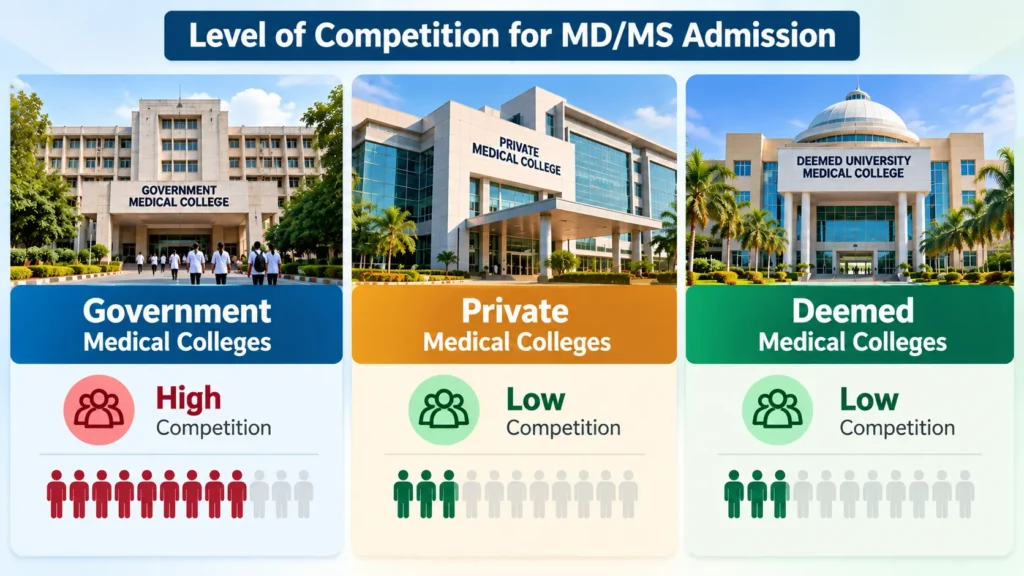
5. Government vs Private vs Deemed: Where Is the Competition Higher?

There is no simple answer such as:

Government = high competition
Private = low competition
Deemed = low competition

That would be too simplistic.

Competition depends on several variables:

1. Branch

A highly demanded branch can remain competitive regardless of college category.

2. College

A well-known institution can attract strong demand even when other colleges in the same category have different closing ranks.

3. Seat type

AIQ, state quota, institutional and other applicable seat categories can have different eligibility and competition patterns.

4. Category

Your reservation category can affect the seats available to you.

5. Counselling round

The options available in Round 1 may be different from those available later.

6. Your willingness to compromise

There is a major difference between:

“I want only Radiology in my preferred city.”

and:

“I want a clinical branch and am open to different cities.”

The second student may have a much wider set of possible options.

6. Your NEET PG Rank Is Only the Starting Point

Students often ask:

“What college can I get with my NEET PG rank?” That is an important question, but it is incomplete.

A more useful question is:

“What MD/MS options should I consider based on my rank, category, branch preference, budget and location?”

For example, two students with the same rank may have completely different options because:

  • One wants only a clinical branch
  • One is open to non-clinical branches
  • One has a strict budget
  • One is willing to consider private colleges
  • One wants to stay in a particular state
  • One is willing to move anywhere in India

Your rank tells you where you stand in the merit list.

It does not by itself tell you which option is best suited to your circumstances.

7. Clinical Exposure Should Be a Major Part of Your Decision

  1. Fees and rankings are easy to compare.
  2. Clinical exposure is harder to quantify.
  3. But for MD/MS, it matters enormously.
  4. Before choosing a college, try to understand:

Patient load

A busy hospital can provide residents with exposure to a larger variety of cases.

Case mix

The type of patients and cases handled by the department matters.

Procedures

For surgical and procedural branches, ask what procedures residents actually get exposure to.

Department strength

Look at:

  • Faculty
  • Senior residents
  • Junior residents
  • Department workload
  • Academic activities

Infrastructure

Check:

  • ICU
  • Operation theatres
  • Diagnostic facilities
  • Emergency services
  • Specialty departments
  • Supporting departments

The college name alone cannot tell you all of this.

8. Do Not Ignore Stipend and Residency Conditions

An MD/MS seat is not simply a three-year academic purchase.

You are also committing several years of your professional life to the institution.

Therefore, compare:

  • Stipend
  • Working conditions
  • Duty hours
  • Accommodation
  • Leave policies
  • Academic schedule
  • Thesis support
  • Department culture
  • Clinical responsibilities

Stipend can also change the effective financial burden of your postgraduate education.

A college with a higher fee but a meaningful stipend may have a different financial equation from a college with a lower fee and different stipend arrangements.

Always verify the latest figures directly from official college disclosures.


9. What About Government College With a Less Preferred Branch?

This is one of the most difficult decisions after NEET PG. Suppose you have two options:

Option A: Government college + branch you are less interested in

Option B: Private/deemed college + branch you strongly want

There is no universal answer.

You need to ask yourself:

  • Do I actually want this branch?
  • Can I see myself practising this specialty for many years?
  • How important is the college environment to me?
  • What is the total financial commitment?
  • What is the clinical exposure?
  • What are my long-term career plans?

A postgraduate degree is a major career decision.

Do not choose a branch only because the college is famous.

At the same time, do not choose an expensive seat only because you like the branch name.

You need to evaluate both.

10. A Practical Framework for Choosing Your MD/MS College

Instead of asking:

“Government or private?”

build a shortlist.

For every college, compare these eight factors:

FactorQuestions to Ask
BranchIs this actually the specialty I want?
FeesWhat is the complete course cost?
Clinical exposureWhat is the patient load and case mix?
CollegeWhat is the institution’s academic environment?
LocationCan I realistically live and study there?
StipendWhat is the current stipend?
InfrastructureWhat facilities are available to residents?
Career goalsDoes the program support my long-term plans?

Then divide your options into three groups:

Group 1: Preferred

Colleges and branches you would be genuinely happy to join.

Group 2: Acceptable

Options you would consider if your preferred choices are unavailable.

Group 3: Backup

Options that fit your rank and budget but are not your first preference.

This approach can make choice filling much more structured.

11. Questions You Should Ask Before Paying for an MD/MS Seat

Before you commit to any college, get clear answers to these questions:

About fees

  • What is the complete tuition fee?
  • What is the hostel fee?
  • What deposits are payable?
  • Are there additional mandatory charges?
  • What is the payment schedule?
  • What are the refund rules?

About the department

  • How many faculty members are there?
  • What is the approximate patient load?
  • What procedures are commonly performed?
  • How much hands-on exposure do residents receive?
  • What academic activities are conducted?

About residency

  • What is the current stipend?
  • What are the duty hours?
  • What accommodation is available?
  • What is the leave policy?
  • What are the working conditions?

About the admission

  • Which counselling authority is handling the seat?
  • What type of seat is it?
  • What are the eligibility conditions?
  • What documents are required?
  • What happens if you upgrade in a later round?

Do not rely only on verbal assurances.

Where possible, verify important information through official counselling documents and college disclosures.

Government vs Private vs Deemed Medical College: What Should You Consider?

There is no single answer that works for every NEET PG student. Your decision should be based on the combination of:

NEET PG Rank + Category + Branch + Budget + College + Clinical Exposure + Location + Career Goals

  1. A government medical college may make financial sense for one student.
  2. A private medical college may provide another student with a feasible path to a preferred branch.
  3. A deemed university may become relevant for a student who is open to colleges across India and has the financial capacity to consider the applicable fees.
  4. The important thing is not to decide based on the college category alone.
  5. Decide based on the specific MD/MS seat and your own priorities.

What Should You Do After NEET PG?

If you are confused about your options, start by creating your personal admission profile:

1. NEET PG Rank

2. Category

3. Preferred branches

4. Maximum budget

5. Preferred states/cities

6. Government / Private / Deemed preference

7. Willingness to compromise on branch or location

Once these are clear, you can start building a realistic college shortlist. At Navyut Education, our focus is to help students understand their MD/MS admission options instead of simply giving them a long list of colleges.

If you want help understanding which MD/MS colleges and branches may be relevant to your rank, category and budget, you can speak with our counselling team. Share your NEET PG rank, preferred branch and budget to understand the options you can explore.

Scroll to Top