

Which MD/MS Branch Should You Choose After NEET PG? A Practical Guide by Rank, Career & Budget

Getting a good NEET PG rank is a major achievement. But for many doctors, the real confusion starts after the result.You may have options for multiple branches. You may also have to choose between a preferred branch in a less preferred college and a different branch in a college you like more. Then there are questions about fees, clinical exposure, location, future practice, super-specialisation and lifestyle.

So the question is not simply:

“Which is the best MD/MS branch?”

A better question is:

“Which MD/MS branch makes sense for my rank, career goals, budget and the kind of doctor I want to become?”

This guide explains a practical way to make that decision.

Why Choosing an MD/MS Branch After NEET PG Is Difficult

NEET PG counselling is not only about getting a seat.

It is a decision involving several variables:

  • NEET PG rank
  • Category
  • Preferred branch
  • College
  • Counselling route
  • Fees
  • Clinical exposure
  • Hospital patient load
  • Location
  • Stipend
  • Bond or service conditions
  • Future career plans
  • Possibility of pursuing a super-speciality

The Medical Counselling Committee’s PG counselling process involves choice filling and seat allotment, and the available seat matrix can change during different counselling rounds. That is why looking at one year’s closing rank and assuming that the same option will be available to you can be risky. Your decision should start with your profile and then move towards the available options.

Start With Your NEET PG Rank — But Don't Stop There

Your NEET PG rank is one of the most important inputs in branch selection. But rank alone does not tell you which branch you should choose.

For example, two students with similar ranks may make completely different choices.

One may want:

  • General Medicine
  • Future DM
  • Internal medicine practice
  • A large hospital environment

Another may prefer:

  • Dermatology
  • A more outpatient-focused practice
  • Private practice
  • A different lifestyle

The rank determines what may be realistically available.

Your career goals determine what you should actually consider.

A better approach

Create three categories of options:

Dream options

Branches and colleges you would prefer if the counselling movement works in your favour.

Realistic options

Branches and colleges that appear reasonably aligned with your rank, category and eligibility.

Backup options

Alternatives that you would genuinely be willing to join rather than simply adding random choices to your list.

This approach is much more useful than searching for a single “best branch according to rank.”

MD vs MS: What Should You Consider?

MD and MS are both postgraduate medical degrees, but the nature of training differs by speciality.

NMC’s postgraduate framework describes MD/MS training as competency-based postgraduate education, with clinical disciplines involving practical training, graded responsibility and exposure to diagnosis and treatment.

In simple terms:

MD branches

Generally cover medical and diagnostic specialities.

Examples include:

  • General Medicine
  • Paediatrics
  • Dermatology
  • Psychiatry
  • Anaesthesiology
  • Radiodiagnosis
  • Pathology
  • Respiratory Medicine

MS branches

Generally focus on surgical disciplines.

Examples include:

  • General Surgery
  • Orthopaedics
  • ENT
  • Ophthalmology
  • Obstetrics & Gynaecology

However, don’t choose simply because a branch is labelled MD or MS.

Look at the actual work involved.

Confused Between MD and MS Specializations?

Don’t make a decision based on guesswork. Download our Ultimate MD vs. MS Specialization Comparison Guide to get side-by-side breakdowns of 18+ core branches, including:

  • ⏱️ Typical weekly working hours & call frequency

  • ⚡ Emergency stress & work-life balance scores

  • 🎓 Post-PG DM/MCh super-specialization pathways

How to Evaluate Popular MD Branches

MD General Medicine

General Medicine can be attractive for students who enjoy broad clinical exposure and complex medical cases.

Consider:

  • Patient load
  • ICU exposure
  • Emergency exposure
  • Range of medical cases
  • Faculty strength
  • Future DM options
  • Workload

If you are considering super-specialisation later, also research the pathway from the speciality to the relevant super-speciality.

MD Paediatrics

Paediatrics can suit students who enjoy working with children and managing both acute and chronic conditions.

Before choosing a college, look at:

  • Paediatric patient volume
  • NICU exposure
  • PICU exposure
  • Emergency cases
  • Faculty
  • Procedural exposure

The actual department and hospital environment can make a significant difference to residency experience.

MD Dermatology

Dermatology is often considered by students looking for a speciality with strong outpatient practice and potential private-practice opportunities.

But don’t choose it only because of perceived lifestyle or earning potential.

Consider:

  • OPD volume
  • Variety of cases
  • Procedures
  • Dermatopathology exposure
  • Aesthetic procedure exposure where relevant
  • Faculty
  • Academic environment

MD Radiodiagnosis

Radiology requires a different kind of interest.

You should be comfortable with:

  • Imaging
  • Technology
  • Pattern recognition
  • Detailed interpretation
  • Long periods of focused work

When comparing colleges, check exposure to:

  • CT
  • MRI
  • Ultrasound
  • Emergency imaging
  • Interventional procedures where applicable

MD Anaesthesiology

Anaesthesiology involves much more than administering anaesthesia.

Your residency exposure can include:

  • Operation theatres
  • Critical care
  • Emergency cases
  • Airway management
  • Perioperative medicine
  • Pain-related services

Hospital workload and OT exposure are therefore important factors when comparing colleges.


How Budget Should Affect Your MD/MS Branch Decision

Fees can completely change your available options. This is particularly important when comparing government, private and deemed institutions. Don’t look only at tuition fees.

Calculate the total cost of residency.

Consider:

  • Tuition fees
  • Hostel
  • Food
  • Other institutional charges
  • Examination-related expenses
  • Living expenses
  • Travel
  • Bond/service conditions
  • Stipend

For example, a college with higher tuition may look expensive initially, but the financial calculation should consider the full three-year cost and stipend structure. Similarly, a lower-fee option may not automatically be suitable if the branch, location or clinical exposure does not match your priorities.

Rank vs Branch vs College: What Should You Prioritise?

This is where many students get stuck.

There is no single rule that works for every student.

Instead, compare your options across four dimensions:

FactorQuestion to ask
RankWhat branches and colleges are realistically available?
CareerDoes the branch match my long-term goals?
Clinical exposureWhat will my residency actually look like?
BudgetCan I comfortably manage the total course cost?

Then add:

  • Location
  • Stipend
  • Bond/service conditions
  • Future specialisation
  • Family considerations
  • Private practice plans
  • Academic/research interests

Your final choice should come from the combination of these factors, not from rank alone.

A Practical MD/MS Branch Selection Framework

You can use this six-step process.

Step 1: Start with your NEET PG profile

Record:

  • Rank
  • Category
  • State
  • Domicile where relevant
  • Counselling routes you are eligible for

Step 2: Identify your preferred branches

Don’t start with 30 branches.

Start with your top 3–5 preferences.

Then identify acceptable alternatives.

Step 3: Build a realistic college list

For every preferred branch, identify colleges that are realistically relevant to your rank and category.

Remember that seat availability and counselling rules can change across rounds and years. MCC publishes current seat matrices, choice-filling notices and counselling updates during the process.

Step 4: Compare the colleges

Compare:

  • Fees
  • Stipend
  • Patient load
  • Clinical exposure
  • Procedures
  • Faculty
  • Infrastructure
  • Location
  • Hostel
  • Bond/service conditions

Step 5: Calculate your actual budget

Look at the complete three-year cost rather than only the advertised tuition fee.

Step 6: Create your choice list

Now organise your options into:

Dream → Realistic → Backup

This gives you a structured choice list instead of a random list of colleges.

Final Thought

Your NEET PG rank opens the door.

But your branch choice can shape the next several years of your medical career.

So don’t make the decision only because:

  • a branch is popular,
  • a college has a big name,
  • someone told you it has better scope,
  • or you saw a particular closing rank online.

Look at the complete picture:
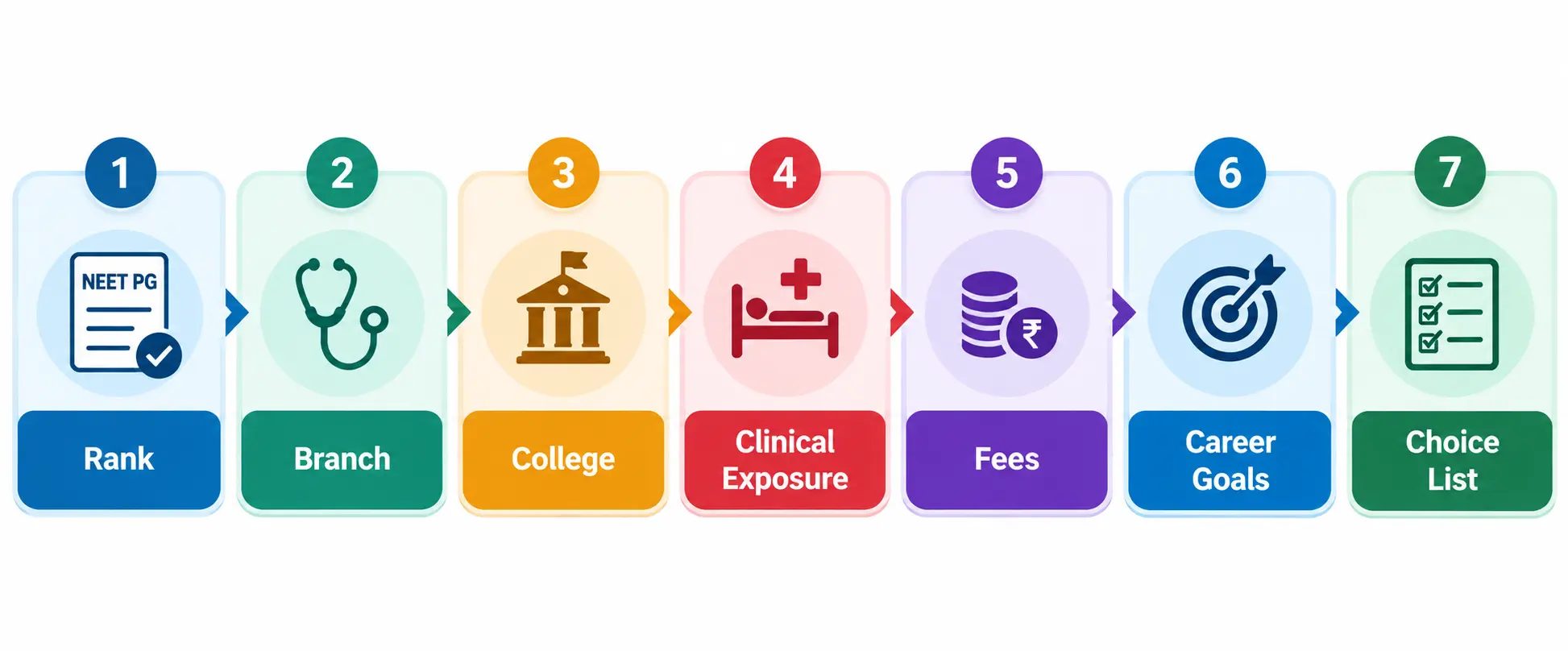
That is a much more practical way to approach MD/MS counselling.

Scroll to Top